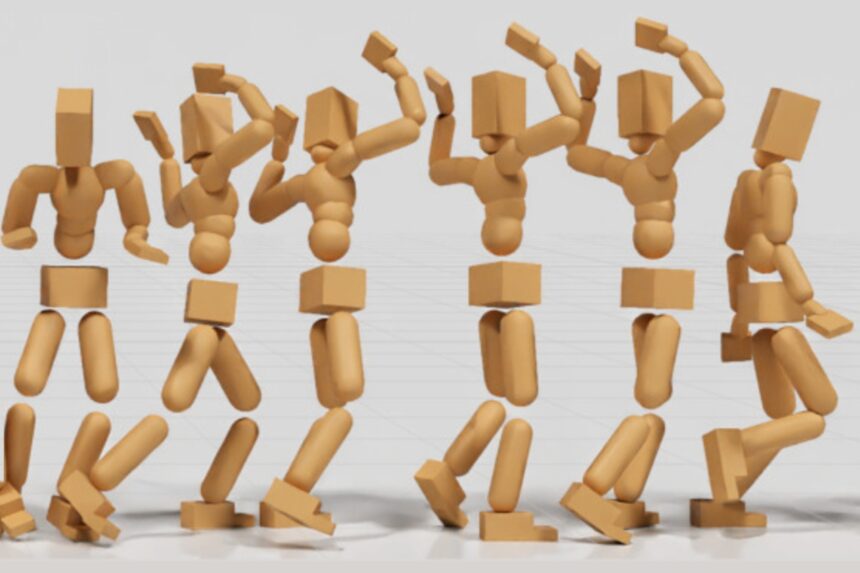
Disney Research has shared a system that lets a person steer a robot while changing its movement style in real time. The project, called “Walk Like This,” separates where a character moves from how it moves, using an example clip to guide its style and joystick commands to control its velocity.
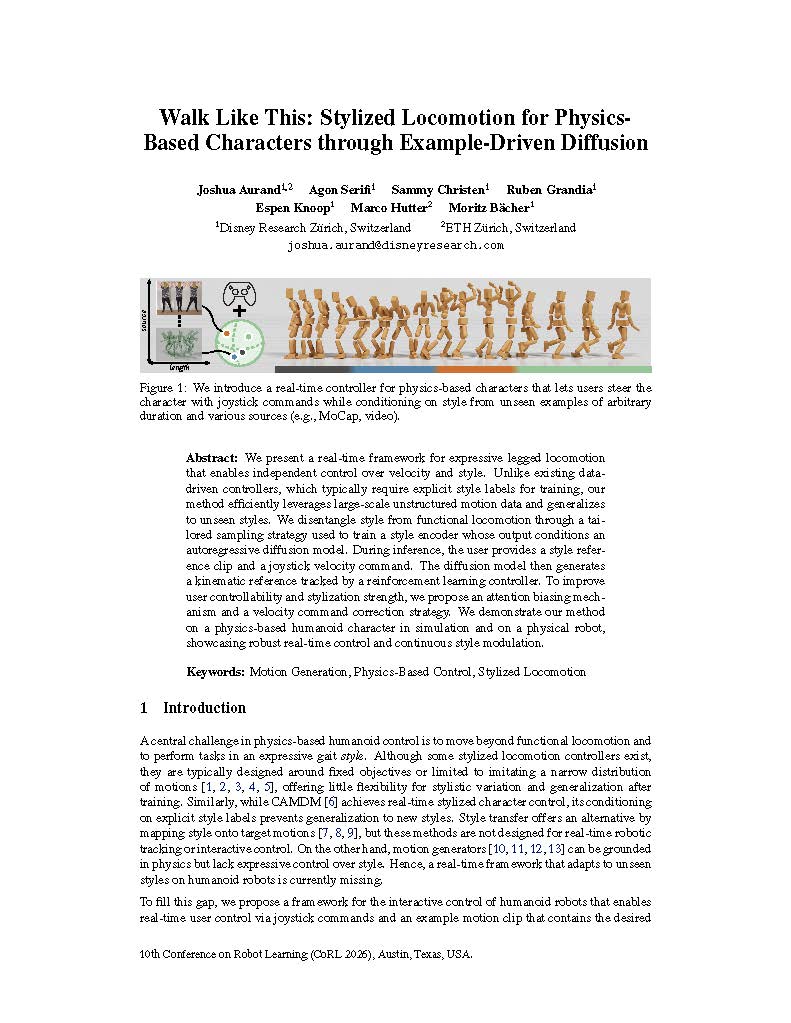
The team demonstrated the approach on a physical humanoid robot as well as a simulated character.
A movement example, not a fixed style menu
The research was published on Disney Research’s website on October 11, 2026, for the Conference on Robot Learning. Researchers from Disney Research and ETH Zurich developed the framework to work with movement styles it had not encountered during training.
Rather than requiring a predefined label for each style, the system takes a reference motion clip and extracts its stylistic features. A person can then provide joystick commands while the system generates movement that follows both inputs. The reference sets the manner of movement, while the joystick sets the requested velocity.
The paper describes style examples coming from motion capture or video, with clips of different lengths. In one experiment, the researchers recorded a person performing a movement, extracted motion information using pose estimation, and supplied those features to the style encoder without additional processing.
Turning generated motion into physical movement
A diffusion model generates the reference motion, and a reinforcement-learning controller tracks it on the physical character. These are separate parts of the system: generating a desired motion does not, by itself, make it possible for a real robot to perform.
The researchers also developed attention biasing to strengthen the requested style and a velocity correction strategy to improve how closely the generated motion follows a person’s commands. The framework supports continuous style modulation.
For the hardware demonstration, the team used a Unitree G1 humanoid robot measuring 1.32 meters tall and weighing 35 kilograms, with 29 degrees of freedom. The researchers transferred human motion data to its body using ReActor before training and deploying their model.
According to the paper, the robot performed varied trajectories and velocity commands across different styles during approximately four hours of deployments without failures. The diffusion model ran on an onboard NVIDIA Jetson Thor, with approximately 11 milliseconds per inference step and 17 milliseconds from command to motion output.
What Disney actually demonstrated
The new publication is a research demonstration of expressive locomotion, not an announcement of a named Disney character or a scheduled Disney Parks appearance. Its focus is a controller that can follow a person’s directional input while adapting the character’s style from an example.
Related: More Disney news and Disney technology.
Source: Disney Research, the research paper.
Discover more from Theme Park Shark
Subscribe to get the latest posts sent to your email.